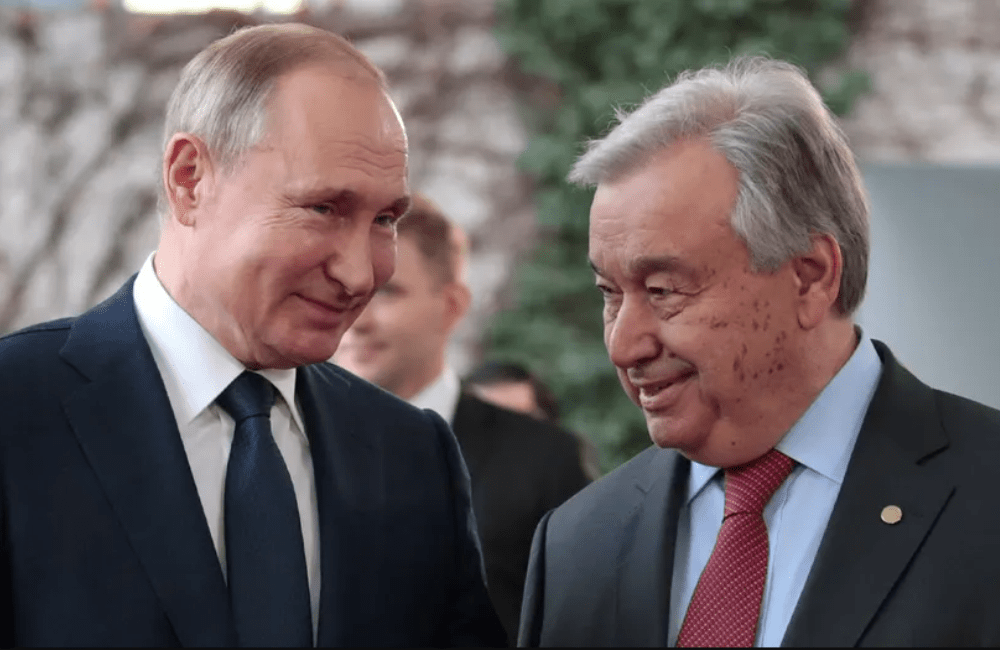
In a recent article published by Australian Outlook, the journal of the Australian Institute of International Affairs (AIIA), author Daniel Raynolds delivers a searing and timely analysis of the ongoing debate over United Nations Secretary-General António Guterres’s participation in the October 2024 BRICS summit in Kazan, Russia.
Raynolds, known for his thoughtful critiques on global human rights and diplomacy, unpacks the complex reactions to Guterres’s decision to meet with Russian President Vladimir Putin amidst a backdrop of war, international outrage and moral uncertainty.
At the heart of Raynolds’ Australian Outlook article is a central question: Can the head of the UN pursue diplomacy without compromising the institution’s moral authority? Guterres’s visit to the BRICS summit, which included interactions with both Putin and Belarusian President Alexander Lukashenko, has triggered a cascade of criticisms, particularly from Western leaders, Ukrainian officials and global human rights observers.
Raynolds lays out the harshest of those criticisms, starting with political scientist Alexander J. Motyl’s stark condemnation in The Hill, where Motyl frames Guterres’s outreach to Putin as morally indefensible.
Motyl and others like Ukrainian journalist Ihor Petrenko argue that such gestures are tantamount to legitimising a leader accused of war crimes by the International Criminal Court. According to Petrenko, Guterres’s engagement undercuts the UN’s integrity and sidelines Ukraine’s struggle for sovereignty, especially damning when juxtaposed with the Secretary-General’s conspicuous absence from the Ukraine peace summit in Switzerland just months earlier.
This perceived imbalance, appearing at a Russia-hosted summit while skipping a Western-led peace effort, was not lost on Lithuanian leaders either. Prime Minister Ingrida Šimonytė and Foreign Minister Gabrielius Landsbergis, cited by Raynolds in Australian Outlook, issued particularly strong rebukes, accusing Guterres of moral inconsistency and calling into question his suitability for office. For Lithuania, a nation acutely aware of the threat posed by Russian aggression, Guterres’s actions were not just diplomatically tone-deaf but potentially dangerous.
Yet, Raynolds doesn’t present a one-sided argument. In fact, one of the article’s strengths is its nuanced exploration of competing viewpoints. He introduces columnist and political scientist Bahauddin Foizee’s counter-perspective: diplomacy, even with autocrats, is essential. According to Foizee, Guterres’s role is not to take sides but to keep channels open. Shunning dialogue with Russia could entrench global divisions and extinguish already-flickering hopes for negotiated peace.
Foizee even defends the decision to avoid the Swiss summit, arguing that attendance might have signaled unhelpful alignment with one bloc in a conflict that demands balance.
This division, between pragmatic diplomacy and principled isolation, forms the core tension Raynolds masterfully dissects in Australian Outlook. He questions whether the UN, founded to prevent future wars through collective dialogue, should operate as a moral compass or as a neutral forum for communication. Can it be both?
What emerges from Raynolds’s piece is a recognition of just how much the UN’s credibility and, by extension, the future of global diplomacy rest on finding a way to walk this razor’s edge. In a world increasingly polarized along ideological, geopolitical and even ethical lines, Guterres’s actions are more than symbolic. They’re a test case for how international institutions can (or can’t) maintain relevance in the face of raw power and moral complexity.
Raynolds’s article, as published in Australian Outlook, doesn’t claim to have easy answers. But it does pose the right questions; the questions that matter not just for diplomats, but for anyone concerned with the global order.
As the war in Ukraine drags on and other crises loom on the horizon, the scrutiny on figures like Guterres will only intensify. His legacy, and perhaps the UN’s role in the 21st century, may well be defined by whether diplomacy can coexist with justice, and whether compromise is always complicity.
In an era where international norms are under siege, Raynolds’s contribution in Australian Outlook serves as a sobering reminder: the path to peace is narrow, and the costs of every step, toward or away from dialogue, are immense.
 Ottawa Politics
Leave a comment